Referral line for registered restumpers · Geelong, the Bellarine and Torquay
Restumping, Geelong
Floors sloping, doors sticking or cracks above the doorways? Tell us what you're seeing, and we'll connect you with a registered restumper who works in your suburb.
Calls answered 24/7 by our virtual assistant
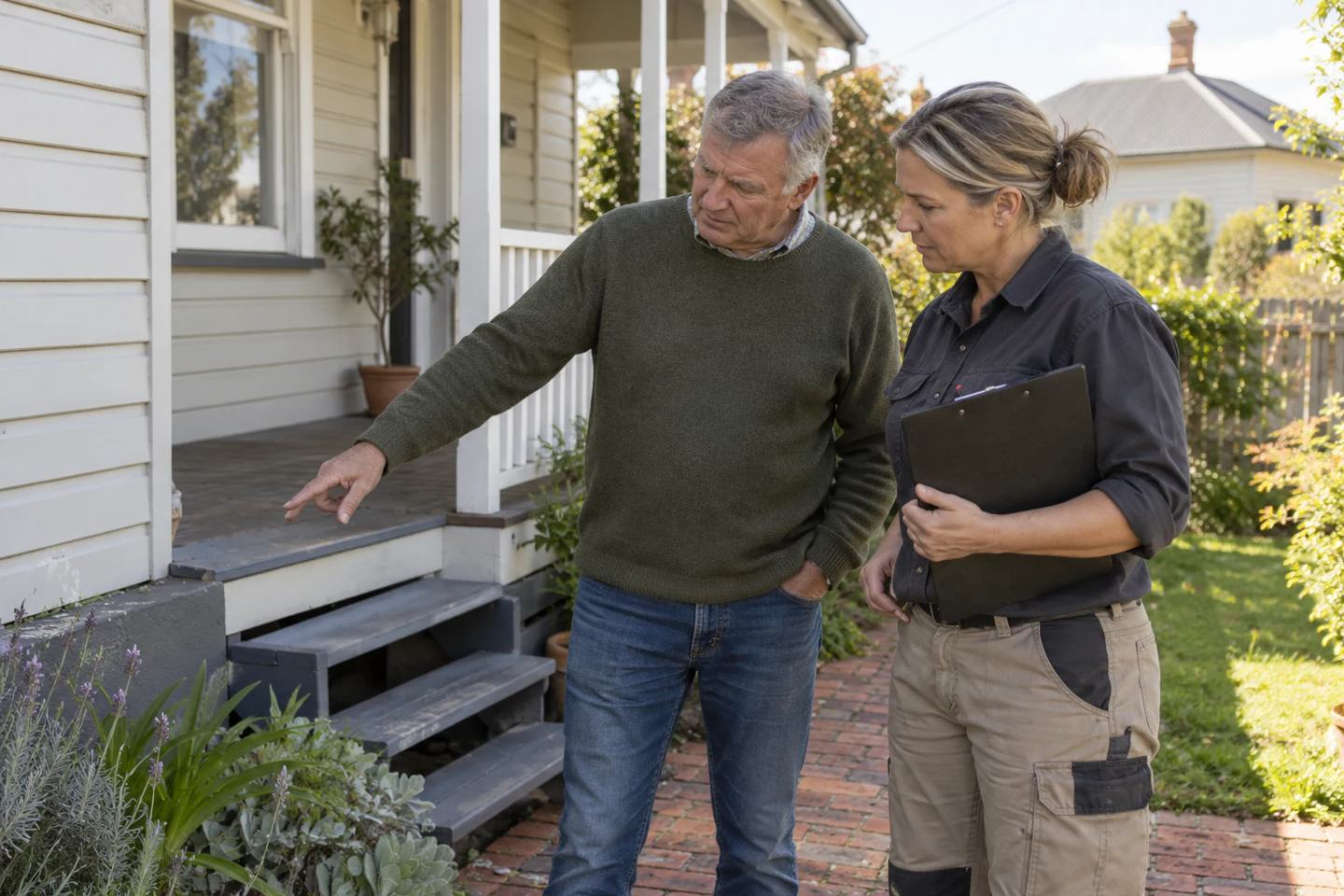
Start with an inspection of your house
Sloping floors, sticking doors and cracks above doorways can mean the stumps or footings under a house have moved. They can have other causes too, and only an inspection tells. In Victoria, anyone who restumps or reblocks a home must be registered with the Building and Plumbing Commission (BPC), whatever the job is worth (Consumer Affairs Victoria). Restumping, reblocking and underpinning need a building permit (Campaspe Shire building fact sheet); the builder or a building surveyor usually arranges it. If your home is in a Heritage Overlay, check with the City of Greater Geelong before work starts: raising the house, or anything that changes how it looks from outside, may need a planning permit as well (City of Greater Geelong). Check the restumper's registration on the BPC's public register before you sign. With your permission, we pass your details to one registered local restumper, and they call you back.
What you're seeing, and what it can mean
- Floors sloping or bouncy
- A floor that slopes or dips can mean a stump or footing has dropped, or the ground under it has moved. The BPC lists uneven floor movement among the effects of clay soils shrinking and swelling (BPC). It can also be the timber frame under the floor rather than the stumps. An inspection tells which.
- Doors and windows sticking
- The BPC says foundation movement can make windows and doors stick or distort (BPC), but it isn't the only cause. Note which doors and windows, and whether it changes with the weather.
- Cracks above doors and windows
- The BPC treats wall cracks under 1 mm wide as normal movement. It says cracks of 1 to 5 mm should be watched through a full year, and cracks over 5 mm are significant (BPC). Measure them, photograph them and write down the date.
- Gaps between the skirting and the floor
- A gap that opens as the floor drops away from the wall is one form of uneven floor movement. Note where it is and how wide it is. The inspection looks at what's happening under that part of the floor.
- A musty or damp smell under the house
- The BPC lists musty or damp smells among the signs of a moisture problem, and says mould grows best in damp, poorly ventilated areas (BPC). Check the subfloor vents aren't blocked and that water isn't running under the house. On its own, it isn't a sign the stumps have moved.
- You're buying an older weatherboard house
- Have the subfloor looked at before you buy, and ask for the permits from any past restumping. The City keeps a register of building permits issued in the last 10 years (City of Greater Geelong). Age alone doesn't mean a house has moved.
What's under the floor, and what goes wrong
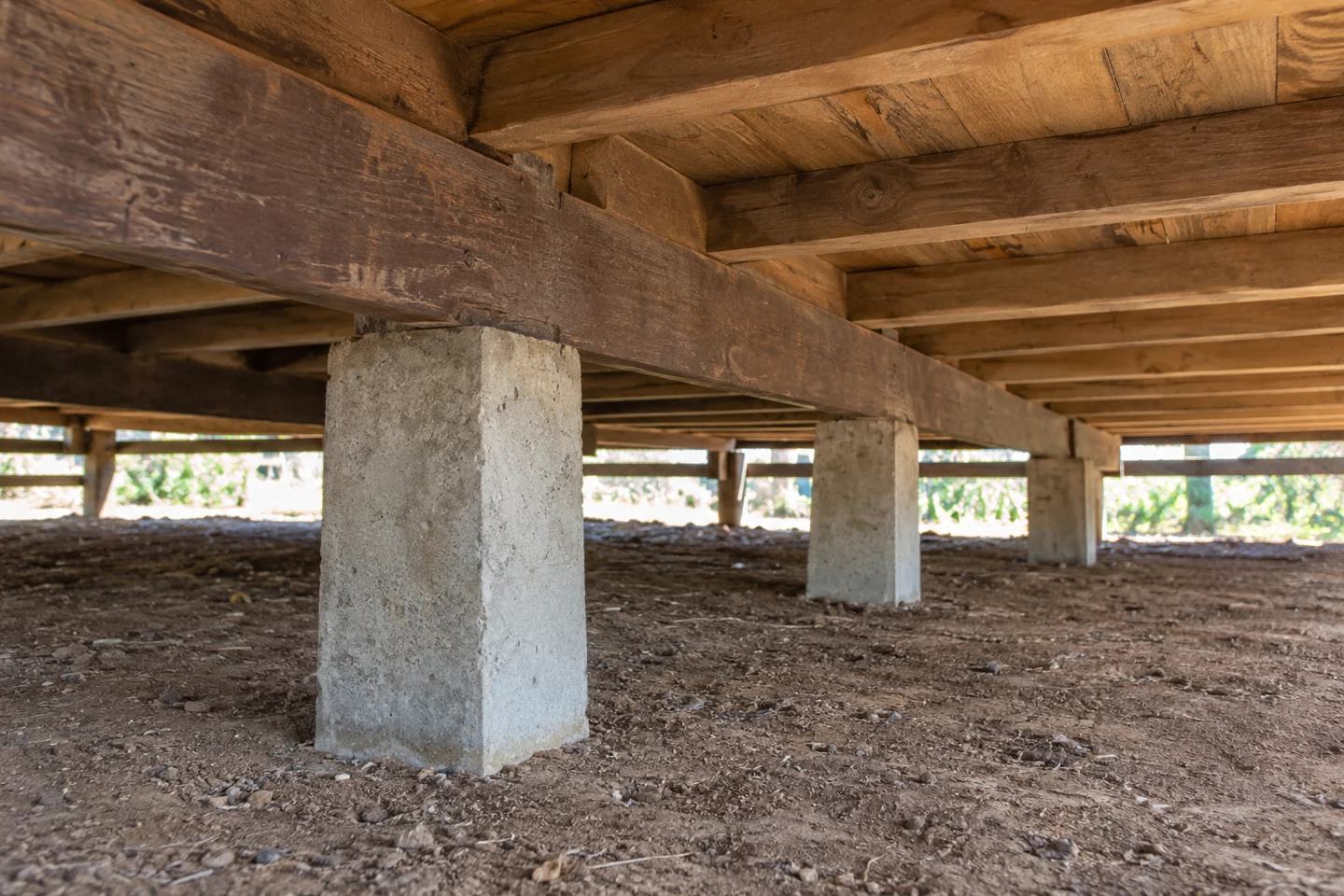
A timber floor on stumps sits on a frame of bearers and joists, held up by stumps standing on footings in the ground (YourHome). When one footing sinks, or the ground under it moves, the part of the floor above it drops with it. The drawing shows one stump that has sunk.
Stumps and footings
Each stump stands on a footing and carries part of the house's load down into the ground (YourHome). The BPC lists changing moisture in the soil, soil settling, erosion of sandy soil and tree roots growing under footings as causes of footing movement. In the drawing, one stump has sunk.
Bearers
The timbers that sit on top of the stumps. A council's restumping permit checklist asks for a drawing of how the stumps connect to the bearers (Moira Shire). When a stump drops, the bearer over it loses support.
Joists
The timbers the floor is laid on. With the bearers, they make the frame that the stumps and footings hold up (YourHome).
Floorboards
The floor you walk on. When the frame under it drops, it slopes or dips. After restumping, the BPC's tolerance guide says re-levelled floors shouldn't differ by more than 15 mm across a room, or 8 mm in any 2 metres, in the first 24 months (BPC).
Subfloor vents
Openings in the base of the outside wall that let air through the space under the floor. The BPC's tolerance guide says render and other finishes must not get in the way of sub-floor ventilation (BPC), and its mould guide says mould grows best in damp, poorly ventilated areas (BPC). Keep them clear.
Cracks and sticking doors
The BPC says foundation movement can crack walls and floors, make walls bulge, and make windows and doors stick or distort. It treats wall cracks under 1 mm as normal movement and cracks over 5 mm as significant.
The ground
A soil test classifies how reactive a site's soil is: how much it shrinks or swells as its moisture changes, from A (sand and rock, little or no movement) to E (extremely reactive clay). The BPC says leaking gutters, taps and pipes, poor drainage and trees near the house can all change the moisture under footings.
Source: Building and Plumbing Commission: Minimising foundation movement and damage to your house
Restumping and related work we can connect you with
How it works
You call or send the form
Calls answered 24/7 by our virtual assistant. The assistant asks what's happening, where, and how urgent it is.
You say yes to sharing your details
We only pass your details on with your permission, and only to one registered restumper.
A local restumper calls you
An independent BPC-registered restumper working in your suburb calls you back to talk about the job and the price.
Why houses move around Geelong
Older timber houses and post-war estates
Victorian Places says most houses in Geelong West are single-storey timber buildings, from cottages to Californian bungalows. In Norlane, the Housing Commission built 2,464 houses between 1947 and 1976 (Victorian Places), and a report excerpt published by the City says most were modest weatherboard houses (City of Greater Geelong). Age alone doesn't mean a house has moved: an inspection tells.
Reactive clay at Lovely Banks
A 2017 geotechnical study of the Lovely Banks investigation area, in Geelong's north, found highly reactive basaltic clay soils throughout, and said these clays shrink and swell with the seasons. That finding is for Lovely Banks only. Across the state, the BPC says clay-rich expansive soils are widely distributed (BPC). Only a soil test tells you what's under your own house.
Heritage overlays
Many older streets are in heritage overlays, among them Drumcondra and Rippleside (HO1630), Shannon Avenue in Newtown (HO1920), Belmont Heights (HO1908) and central Drysdale (HO1620). In a heritage precinct, the City says external buildings and works need a planning permit, even for a house with no significance of its own. Check with the City before work starts.
The October 2022 floods
When the Barwon River flooded in October 2022, the City reported about 7,000 sandbags filled and handed out from St Albans Reserve in Thomson. Roads stayed closed around Breakwater, South Geelong and Highton (Geelong Independent). The BPC says foundation movement is often caused by changing moisture in the soil.
Restumping and reblocking are the same job
You’ll see both words. They describe the same work: replacing the stumps that hold up a timber floor, then re-levelling the floor on the new ones. The BPC registers restumpers in one class, “Domestic Builder (Limited to Re-stumping and Re-blocking)” (BPC). Councils handle them as one kind of permit application (Macedon Ranges Shire).
A house on a concrete slab, or brick walls on strip footings, is a different job. See underpinning.
Before the inspection
Write down what you’ve noticed and when. Measure any cracks and photograph them with something for scale. The BPC says cracks between 1 and 5 mm wide should be watched in all weather over a full year, so dated photos help (BPC).
Look for water too. The BPC says to repair leaking gutters, hot water systems, air conditioners, tanks, taps and hoses promptly, and to slope soil, paths and garden beds away from the house so water doesn’t run towards the footings.
What the inspection looks at
Ask the restumper what they’ll check. The BPC’s Guide to Standards and Tolerances lists what matters when restumping an existing house: the structure as it is, including how far it has already moved; how the new work fits with the old; the plumbing and wiring under the house; the chance of damage to the rest of the house; and anything that limits how far the floor can be re-levelled (BPC).
A soil test may be part of it. Consumer Affairs Victoria says foundation data, including a report based on soil tests, recommends the depth of stumps (Consumer Affairs Victoria). For significant cracking, the BPC says the cause should be investigated by an endorsed civil or structural engineer.
Registration, and how to check it
In Victoria, anyone who restumps or reblocks a home must be registered with the Building and Plumbing Commission (BPC), whatever the value of the work (Consumer Affairs Victoria). The BPC, formerly the Victorian Building Authority, was set up on 1 July 2025 (Planning Victoria).
Check before you sign. The BPC’s public register shows whether a builder’s registration is current, what type of work they can do, and any conditions on it (BPC). Registered building practitioners (other than companies) are issued a photo ID card that lists their category of registration (BPC). Using someone unregistered matters: Home Warranty doesn’t protect homeowners who use an unregistered builder for work that must be done by a registered one (BPC).
The building permit
Restumping, reblocking and underpinning need a building permit (Campaspe Shire building fact sheet). The builder or a building surveyor usually arranges it. In Greater Geelong, the City’s Building Services Unit issues permits, or you can appoint a private building surveyor. The surveyor checks the plans, and checks that the builder meets the registration and insurance requirements, before issuing the permit (City of Greater Geelong).
Heritage overlays
If your home is in a Heritage Overlay, check with the City of Greater Geelong before work starts. Raising the house, or anything that changes how it looks from outside, may need a planning permit as well as a building permit. In a heritage precinct, the City says external buildings and works need a planning permit, and places on the Victorian Heritage Register need permits from Heritage Victoria (City of Greater Geelong). Torquay is in Surf Coast Shire, so ask the Shire there.
Contracts, Home Warranty and the Notice of Cover
Get the job in writing. For larger jobs, the contract is a major domestic building contract, which comes with a five-day cooling-off period (Consumer Affairs Victoria).
For larger jobs the builder must arrange Home Warranty insurance through the BPC. Ask for the Notice of Cover. When it arrives, check that the builder’s name, registration number and ABN, the site address and the work covered match your contract, and keep it with the contract, plans and permits (BPC).
Restumping can crack plaster. The BPC’s tolerance guide says the limits on damage should be specified and agreed before work starts (BPC). Put them in the contract.
Stumps
Ask which type of stump the restumper proposes (concrete, steel or timber), how deep the holes will go, what the stumps will sit on, and how they’ll connect to the bearers. A Victorian council’s permit guideline asks for these same details: the stump type and size, the hole depth and width, and the sole plate, along with the method of termite treatment (Macedon Ranges Shire).
If you rent
Tell your rental provider or property manager in writing as soon as you notice a problem. Rental providers must make non-urgent repairs within 14 days of a written request. Any fault or damage that makes the property unsafe, including damp caused by or related to the building structure, is an urgent repair (Consumer Affairs Victoria).
Suburbs we cover
Registered restumpers across the City of Greater Geelong area. Pick your suburb for local details.
Questions people ask
How do I know if it's the stumps?
You can't be sure from the signs alone. Cracks and sticking doors have other causes too. A restumper inspects under the floor and tells you what they find. For significant cracking, the BPC says the cause should be investigated by an endorsed civil or structural engineer (BPC).
How much does restumping cost?
It depends on the house and what the inspection finds, so the restumper quotes after inspecting. We don't publish prices, because we haven't found a reliable local source for them.
Will restumping crack my plaster?
It can. The BPC's tolerance guide says damage is likely enough that the limits should be specified and agreed before work starts (BPC). Ask the restumper what they expect, and put it in the contract.
How long does it take, and can we stay in the house?
It depends on the house and how much needs doing, so ask the restumper when they quote. We don't publish timeframes.
Are you a restumping company?
No. House Restumping Geelong is a referral service. We're not connected with the BPC or the City of Greater Geelong. With your permission, we pass your details to one independent restumper registered with the BPC, and you deal with them directly. See our referral marketing disclosure.
Floors sloping or doors sticking? Talk to a registered local restumper.
- BPC-registered local restumpers
- Your details go to one business, only with your permission
- No charge to you for the referral